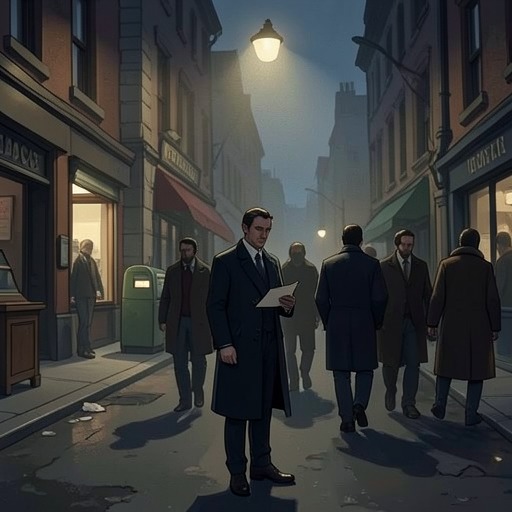
The home invasions
The ShardsThe home invasions are a serial campaign of intrusions across Los Angeles that turns scattered neighborhoods into a connected field of threat. Beginning in May 1980, the incidents develop from furtive signs of an unseen presence into a recognizable pattern involving missing animals, silent calls, and assaults; for Bret Ellis, the pattern becomes both a warning and an obsession that drives him to follow Robert Mallory.
Early Intrusions and Geographic Spread
The first wave began in May 1980, initially seeming like tests rather than full attacks. In June, someone recalled hearing veranda wind chimes on Oakfield Drive in Sherman Oaks on a night without a breeze. In July, a witness on Woodcliff Road reported a flashlight beam and a black-clad figure beside a pool, holding a butcher knife. During that summer the intruder’s appearance remained uncertain: witnesses variously described a tall or not-so-tall, lean or heavy figure, sometimes claiming to see strikingly different eye colors and sometimes no eyes at all. The black ski mask, jeans, and turtleneck obscured a stable identity.
The intrusions nevertheless formed a substantial geographic pattern. Twenty break-ins occurred in homes below Mulholland on the San Fernando Valley side, stretching from Studio City through Sherman Oaks and Encino, with brief incursions into Bel Air and Benedict Canyon. Later incidents appeared in Pasadena, Glendale, and Hollywood before the campaign abruptly stopped. It resumed in mid-December and continued through January 1981. The spread across residential districts, followed by pauses and sudden returns, made the threat difficult to reduce to one neighborhood or one continuous wave.
The Pattern of Preparation
The invasions were linked to signs of advance preparation. In accounts later reported in the Los Angeles Times, targeted residents described calls in the preceding week, furniture moved, or household details changed. Some victims recalled that something in a kitchen, bathroom, or bedroom had been altered, leading investigators to suspect that the intruder had entered and familiarized himself with a home before attacking. Silent calls, sometimes made from phone booths along Ventura Boulevard, Burbank, or Reseda, and from locations across the canyons toward Sunset and Hollywood, added another form of surveillance: the caller listened as the person answering moved from confusion to annoyance and then fear.
Missing pets were another recurring warning. The pattern could involve a victim’s own animal and pets from elsewhere in the same neighborhood, including dogs, cats, birds, snakes, mice, rabbits, or guinea pigs. In some cases, three animals in a neighborhood were sacrificed before an assault. The reason for this practice and what was done with the remains only became clear in late fall 1981, so the early disappearances first appeared as a disturbing but unexplained accompaniment to the break-ins.
Public Alarm and Bret’s Pursuit
By the autumn of 1981, the renewed attacks had entered the conversations of Bret and his friends. At a dinner, Bret insisted on keeping the house lights on and reported a break-in in Century City the previous Sunday, followed by incidents in Rancho Park and Culver City that week. He noted that the previous invasion had been in June and the one before that in January, leaving nearly six months in which the attacks seemed to have stopped. The missing animals made the return of the pattern feel immediate, while Julie Selwyn’s disappearance added a more personal and frightening uncertainty. Debbie Schaffer pointed out that a missing girl was more upsetting than a missing cat; Bret named Julie and said she had been gone for almost eight weeks, with no trace found.
The attacks also shaped Bret’s reading of later news. A report of another invasion in Woodland Hills described the familiar combination of preceding phone calls, rearranged furniture, a missing neighborhood dog, and a masked assailant who tied a victim to a chair and knocked them unconscious. The victim had not recognized the incident as part of a wider pattern and had not gone to the police earlier. After reading the account alongside a report about the Riders of the Afterlife, Bret wondered whether the cult might be responsible for the invasions and disappearances. The connection remained speculation; the article’s details intensified his sense that the threat could be anywhere.
That fear fed Bret’s pursuit of Robert. After witnessing an intimate conversation between Robert and Matt Kellner in the Buckley parking lot, Bret followed Robert’s black Porsche from Stansbury Avenue toward Ventura Boulevard, convinced in his anxious state that the drive might be connected to Matt. On a later pursuit through Benedict Canyon, Bret kept his distance as Robert turned into the driveway of a secluded two-story house, waited, and watched him leave about ten minutes later. The movements did not prove a connection to the invasions, but the campaign’s atmosphere of hidden entry and uncertain identity made Bret’s surveillance feel to him like an attempt to get ahead of danger.
The same impulse reached a breaking point when Bret saw a beige van idling several houses down the canyon road. He ran after it, fell on the asphalt, and approached again as it paused and then slowly drove away. Bret wondered whether the driver was taunting him, but he failed to see the license plate. He sped along the canyon road toward Sunset Boulevard without finding the van, then drove aimlessly instead of returning to Buckley. The encounter yielded no identification, only another unresolved sighting in a story already built around elusive figures and missed opportunities to see them clearly.
Consequences and Narrative Significance
The home invasions’ effects extend beyond the immediate assaults. Missing animals, unexplained changes inside houses, silent calls, and uncertain sightings make ordinary domestic spaces seem compromised before any attack is confirmed. The pattern also draws Bret into a cycle of vigilance: news reports become clues, familiar routes become pursuit roads, and a van without a known connection to a specific incident can still reignite his need for an answer.
The threat persists beyond the events of 1981 in the adult Bret’s account. In 2006, attempting to write about the autumn of 1981 and the Trawler, he suffered a severe anxiety attack and went to the emergency room at Cedars-Sinai Medical Center. Years later, he recalled that the crisis began a prolonged period of anxiety, insomnia, and alienation. During the writing of the book, memories again became physically overwhelming, and arguments with his partner over what had happened made the act of narrating itself part of the aftermath. The invasions thus remain more than a sequence of crimes: their scattered clues and unfinished explanations recur in Bret’s memory as a pattern he can describe but cannot simply leave behind.
The narrative also keeps the campaign’s geography and identity unsettled. Its activity moves across the valley and beyond it; witnesses cannot agree on the intruder’s appearance; and Bret’s attempts to follow Robert or catch the van produce no decisive confirmation. This gap between repeated signs and conclusive knowledge is central to the invasions’ force: the threat becomes legible as a pattern before it becomes fully understandable.